


One correct vaguepost later, and the ceiling was, in fact, 1974.
Republicans were in a bad situation, as I noted at the outset of my prediction piece. They just happened to be in an even worse position than their own operatives, and frankly Democratic ones, anticipated.
The scale of the romp was staggering:
Democrats won the House popular vote by 14.1 points, winning 31 states, three more than then-Sen. Obama in 2008.
They lost only Trump +13.1 Florida from Obama’s map but offset that with wins in Trump +5.5 Arizona, Trump +2.2 Georgia, Trump +13.7 Texas, and Trump +21.6 Utah.
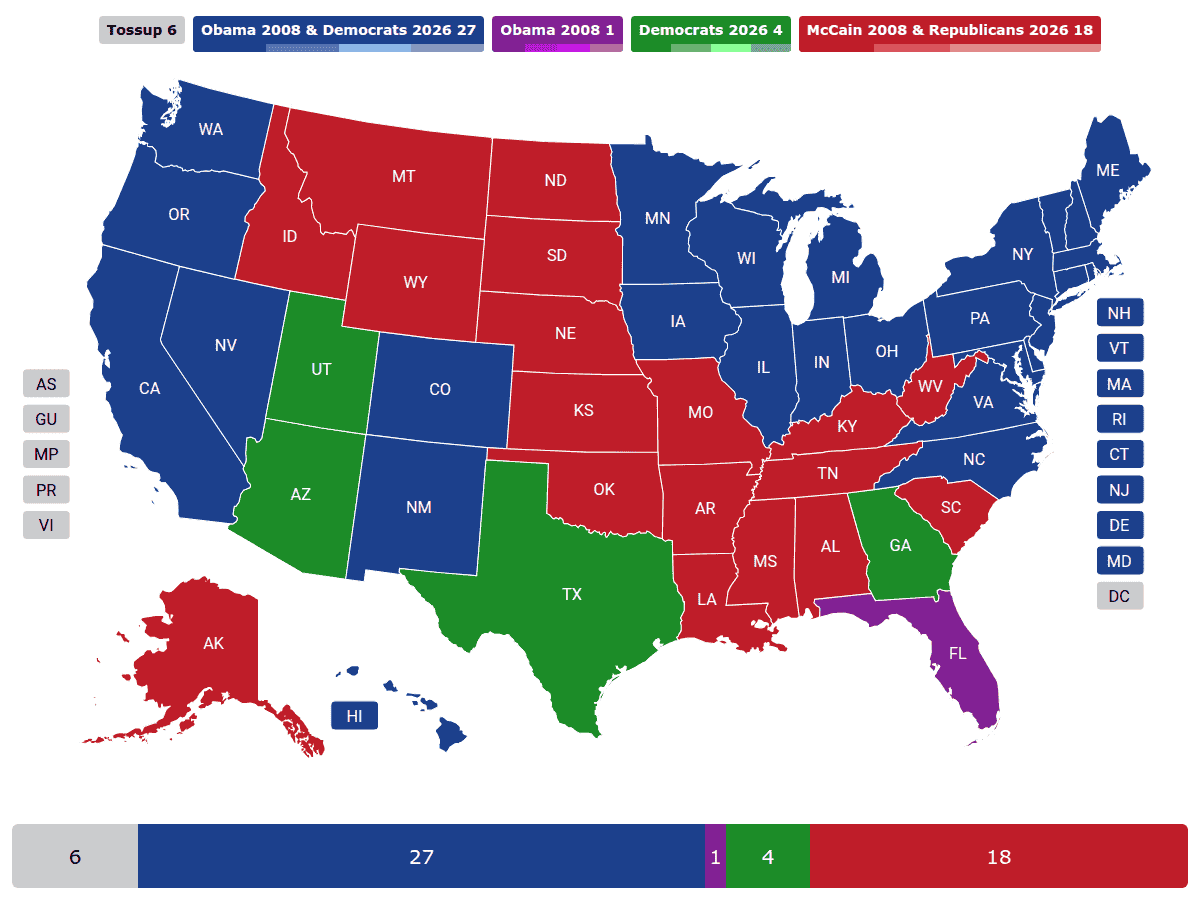
And despite narrowly losing the House popular vote in Trump +13.1 Alaska, Trump +16.1 Kansas, Trump +22.9 Mississippi, and Trump +17.9 South Carolina, Democrats carried Senate races in all four.
Their landslide victory, which delivered majorities in both chambers not seen in decades, did not come completely out of the blue. The same polling miss seen in 2025 happened again: pollsters sampled electorates redder than the one that materialized and missed drastic swings among low-income and minority voters toward Democrats.
Nevertheless, I thought it was worth taking a moment to reflect on my pre-election predictions. How accurate did they end up being?
Senate Postmortem
Predicted: 54D-46R
Results: 56D-44R
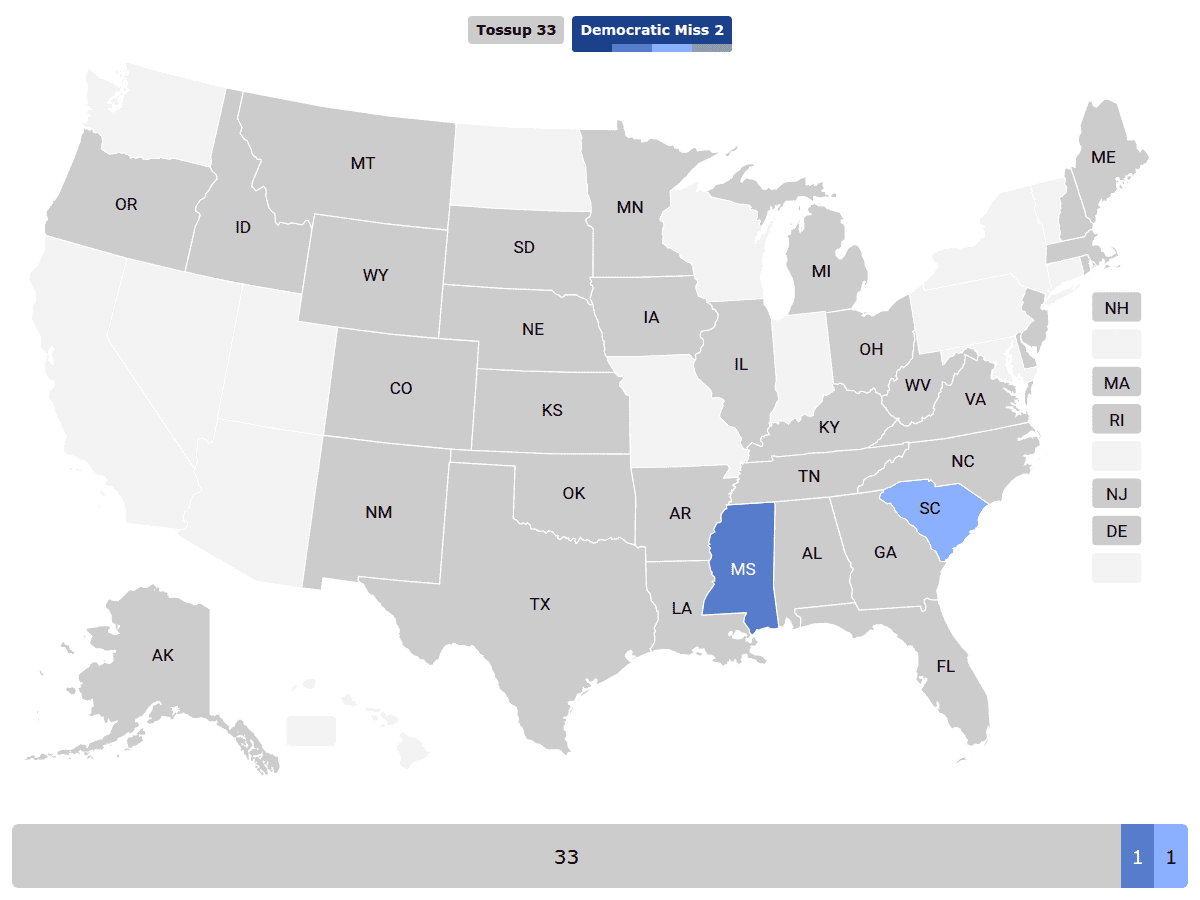
Race winners called right by prediction characterization:
Tilt: 1 of 1 (100%)
Lean: 5 of 6 (83.3%)
Likely: 10 of 11 (90.9%)
Safe: 17 of 17 (100%)
I anticipated a close race in South Carolina and a competitive one in Mississippi, but I’d be remiss if I said I expected Democrats to win either.
My margin-specific predictions fared pretty well in context. I averaged a 3.6-point GOP overestimation, aligning with my expectation of a D+10 year instead of a D+14 one.
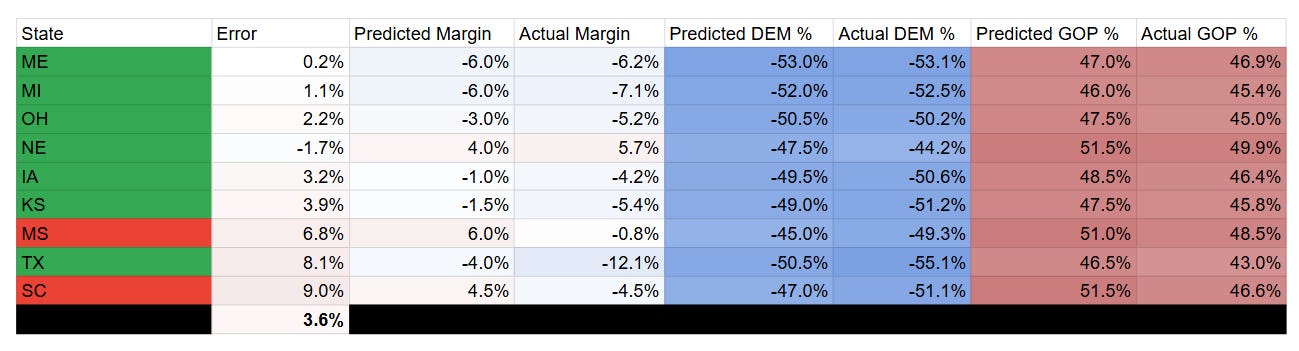
I came within less than 2 points of a perfect prediction in three Senate races: Maine (0.2), Michigan (1.1), and Nebraska (-1.7).
The biggest misses came in Mississippi (6.8), Texas (8.1), and South Carolina (9.0). I underestimated the breadth of the GOP collapse in Texas and failed to adequately account for Hyde-Smith and Graham’s poor candidate quality.
I had been tracking the surge in Black turnout since April’s Voting Rights Act ruling, but the scale of white crossover support for Democrats Andrews and Colom caught me by surprise. Their wins in Trump +22.2 Greenville and Trump +24.1 DeSoto, respectively, were stunning. They were the undeniable breakout stars of the night.
House Postmortem
Predicted: 240D-195R
Results: 260D*-175R*
*3 races uncalled.
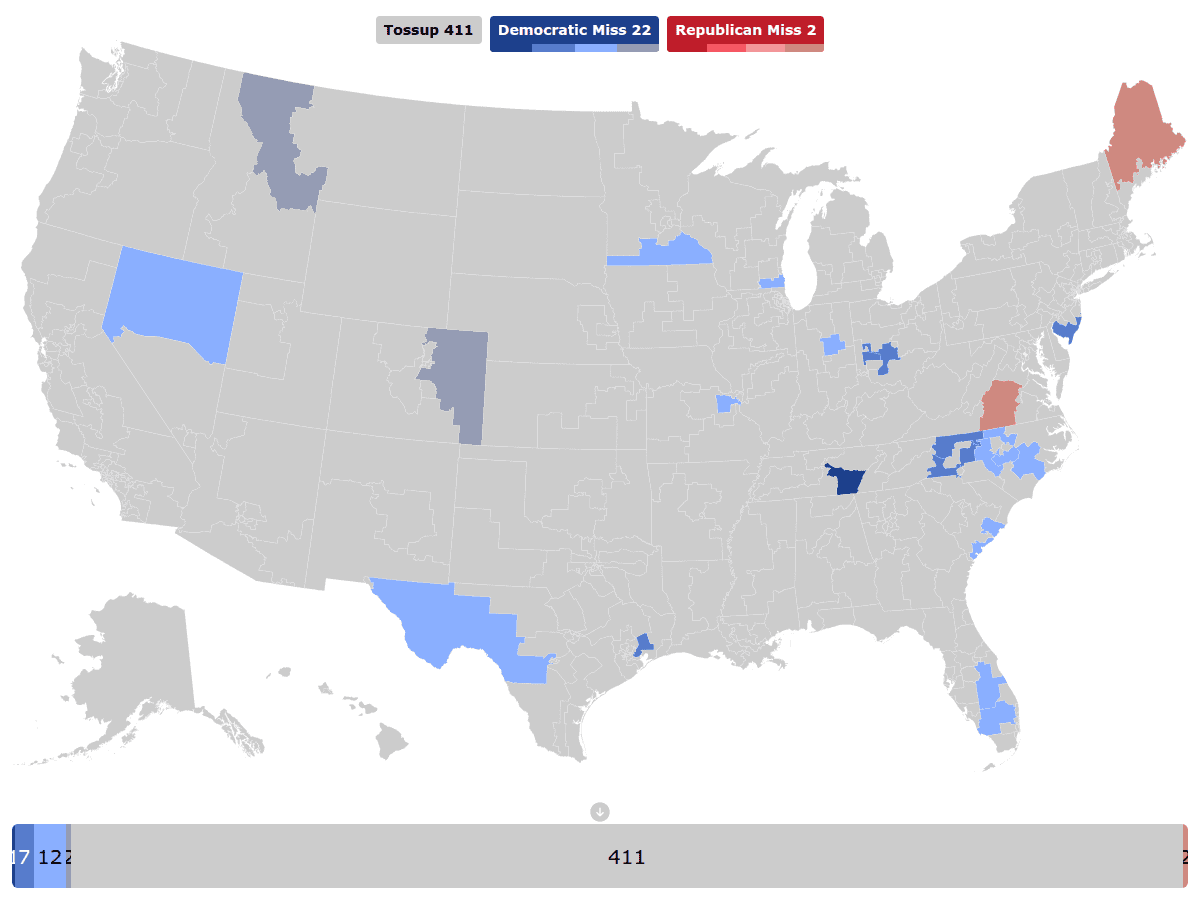
Race winners called right by prediction characterization:
Tilt: 6 of 10 (60%)
Lean: 20 of 32 (62.5%)
Likely: 62 of 69 (89.9%)
Safe: 323 of 324 (99.7%)
With two Louisiana runoffs and one uncalled Minnesota race still pending, expected to break 2R–1D, my House predictions mostly fell in domino order, with Democrats exceeding expectations across the board.
The two Republican misses, VA-05 and ME-02, were somewhat surprising given the national environment. Sen. Collins’ coattails seem to have helped the latter flip Republican, while Virginia lagged behind the nation in the scale of its shift. Republican incumbent McGuire is also a strong candidate who sprang into action after sensing danger during early voting.
I kept the possibility of a tsunami in the cards and had only one big shock: TN-04, where Democrat Broderick won in a “Safe” Republican seat.
Governor Postmortem
Predicted: 28D-22R
Results: 30D-20R
Race winners called right by prediction characterization:
Tilt: 0 of 1 (0%)
Lean: 3 of 4 (75%)
Likely: 18 of 18 (100%)
Safe: 13 of 13 (100%)
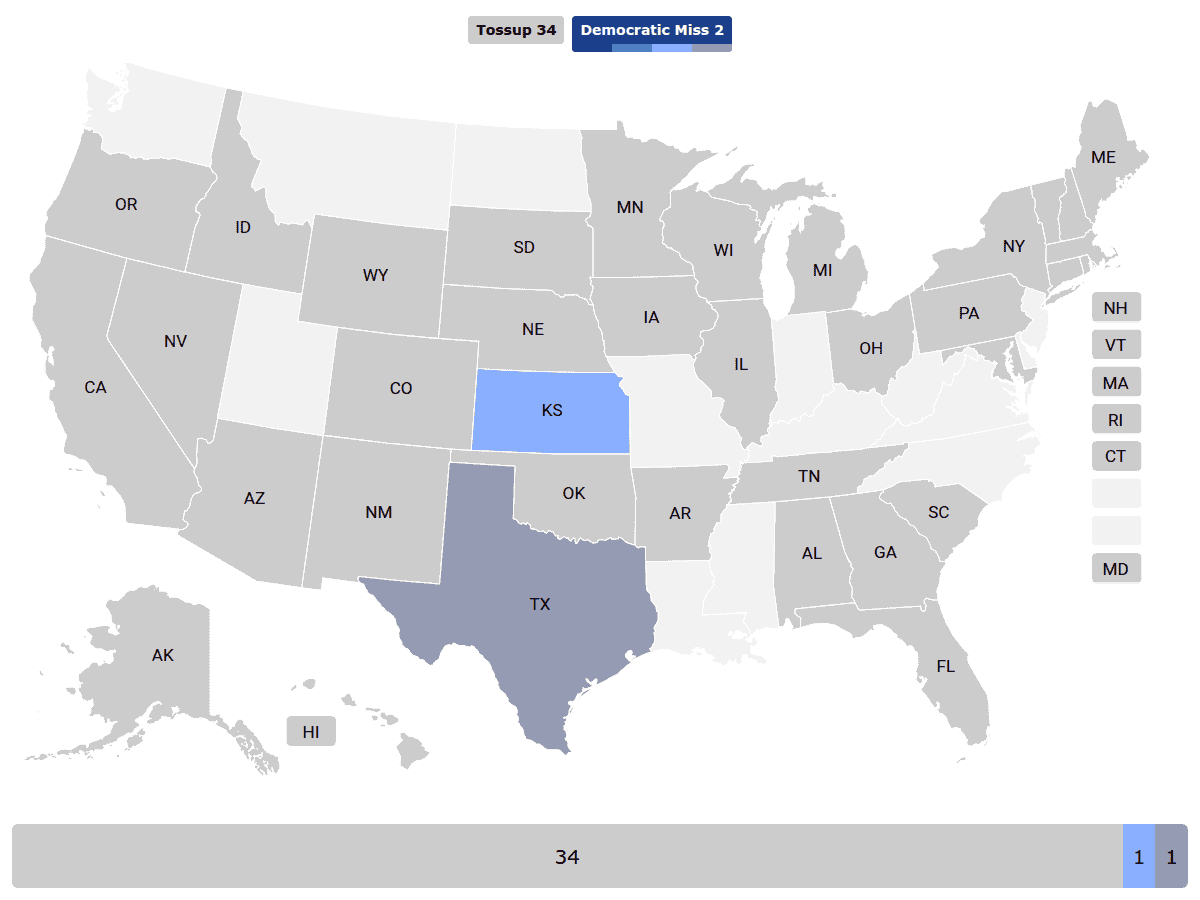
Texas was the only race I rated “Tilt,” and I missed on multiple fronts, predicting a narrow Abbott hold when Hinojosa ultimately won by 7 points. I also missed the cycle’s closest gubernatorial race, Kansas, which I rated “Lean R.”
Sen.-elect Hamilton’s coattails reached farther than expected, helping propel Holscher to a surprise upset. Otherwise, the rest of my predictions held up quite well.