


Yesterday, Haley Stevens hammered her opponent, Abdul El-Sayed, over his alleged general election vulnerabilities. She pointed to his support for progressive policies including Medicare for All and abolishing ICE, as well as his past support for the uncommitted movement in 2024 and a 2020 post calling for the defunding of police during the height of the BLM movement.
Stevens also mentioned that Republicans are boosting El-Sayed’s campaign, suggesting they would rather face him in the general election.
But to understand the kind of voter Democrats need to win back in a state Trump carried, we first have to understand who they lost.
The “Swing” Voter:
Since 2016, nine counties—Marquette, Leelanau, Isabella, Saginaw, Eaton, Kent, Grand Traverse, Muskegon, and Genesee—have been decided within five points in at least one of those three elections.
Of those, Saginaw and Eaton were three-for-three, decided by 1.1 and 4.8 points in 2016, 0.3 and 0.8 points in 2020, and 3.3 and 3.1 points in 2024.
Whoever wins one will likely win the other this year.
In 2024, Harris lost four of the five (Isabella, Eaton, Grand Traverse, Saginaw, and Muskegon), with the latter two being previous Biden-won counties.
Compared to Michigan’s statewide shift of 4.2 points to the right, it was slightly higher in Isabella (5.0) and Genesee (5.1). Grand Traverse shifted left, bucking national trends entirely.
Stevens has aggressively targeted working-class voters in an effort to win back these communities, striking a populist tone since her launch video. It’s also worth noting that Stevens has framed her campaign as a “love letter to Michigan,” aimed primarily at manufacturers and small business owners.
The issue, of course, is that while Stevens has tapped into the ancestral spirit of working Michiganders far and wide, Abdul El-Sayed has been running on a similar populist message. The difference is that, unlike Stevens, who has spent nearly a decade in elected office, the physician is running as an anti-war outsider, unbound by corporate interests. Sound familiar? It’s the same message Trump used to win the state twice.
Fundamentally, El-Sayed and Stevens are both running populist campaigns that rhyme with one another. The contrast comes down primarily to Medicare for All and corporate PAC money, and El-Sayed is on the right side of public opinion on both.
A national YouGov survey conducted last year found that Medicare for All was broadly popular. Six in ten Americans supported the program, including over a quarter of 2024 Trump voters, 67% of moderates, and 58% of independents. Support was above water across every gender, race, income (from under $50,000 to over $100,000), and age group polled, except those over 65.
Medicare for All was also three points more popular than a proposal to increase Medicaid funding (59% vs. 56%).
This is only one poll, but similar surveys from other reputable pollsters, including Pew Research and Gallup, show a consistent trend: Medicare for All is no longer the political liability it once was, if it is a liability at all.
And yes, Michigan often votes to the right of the nation on many issues, but not by nearly enough to turn a 60–30 national issue into a net negative in a 50–50 state with a populist tilt.
Corporate PAC money is also extremely radioactive in Michigan, and both Rogers and Stevens accept it, making El-Sayed unique here as well.
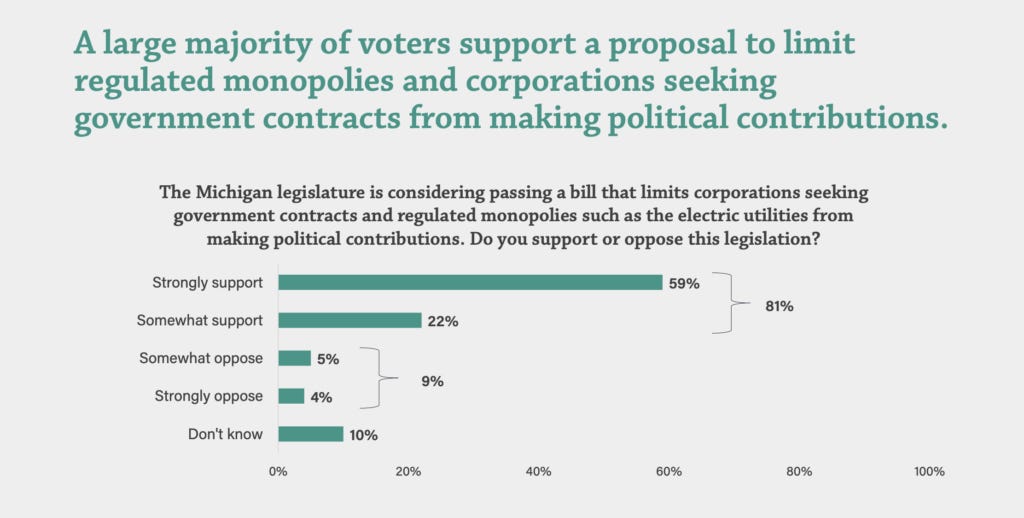
A proposal by the Michigan legislature that would ban corporations seeking government contracts from making political contributions is supported by 81% of Michiganders, according to this survey. The bill heavily parallels a key plank of El-Sayed’s campaign.
This is also backed up by recent national polling by the Brennan Center for Justice: over 60% of voters identified campaign contributions from billionaires (64%) and corporations (62%) as the main cause of corruption.
The debate over AIPAC and Israel fuels much of El-Sayed’s rhetoric on money in politics, and those voters represent another key group the Michigan Democratic nominee must win back.
The “Defector" Voter:
In 2024, the county with the largest rightward shift in Michigan was Wayne County, home to Detroit and, crucially, the heavily Arab American city of Dearborn, shifting by 9.2 points, 3.2 points more than the national average.
Why? Harris ran a campaign at odds with parts of the Democratic base, which stayed home in record numbers while also shifting away from her in record numbers.
To expand on the first point: despite turnout increasing by 7% statewide between 2020 and 2024, Wayne experienced a 2% decline. That’s on top of the second point, in which Harris received a far lower percentage of the vote than Biden, due in part to shifts in the cities of Dearborn (48 points), Dearborn Heights (33 points), and Hamtramck (70 points).
These are usual Democratic bastions, with one thing in common: sprawling Arab American populations.
The war in Gaza and Harris’ dovish stance on restraining Israel pushed voters in these regions away. It also did not help her elsewhere. In Isabella County, the right shift was engineered around Mount Pleasant, home to the college campus of CMU. In Genesee, Harris lost significant ground in the city of Flint, in the most diversifying and youngest precincts.
Voters dislike Israel, and they dislike spending money on foreign conflicts more broadly. A May NYT/Siena survey found that 57% of Americans oppose sending additional aid to Israel, while 54% of voters agree that the U.S. should spend less time on foreign affairs and focus more on fixing problems at home.
Of that number of interventionist-sceptic voters, the largest percentage of those who agreed were Black (74%), White, non-college voters (73%), 18-29 (72%), and nonwhite (69%).
There’s an overlap between this group and the previous “swing” group, which encompasses lower-educated voters.
An anti-war, anti-Israel message is not only key to winning back 2024 defectors, but could also expand the Democratic coalition. El-Sayed has a stronger message to do so.
Stevens, on the other hand, is uniquely vulnerable on this front. While she may be better positioned with traditional swing voters, those gains could be offset if she struggles to win back the same 2024 Democratic defectors who abandoned Harris.
El-Sayed and Stevens are both imperfect candidates. The former’s past statements on policing and his decision to campaign with leftist Hasan Piker open him up to vicious Republican attacks. The latter, meanwhile, risks depressing Democratic turnout and margins among the same voters who cost the party the state in 2024: its own base.
Neither candidate has a clear electoral edge over the other, albeit for different reasons. El-Sayed, on the surface, appears riskier among swing voters, but his campaign is rooted in harnessing the same discontent that delivered Trump two victories in Michigan. Meanwhile, Stevens, while appearing less offensive among the median voter, could infuriate the very core of her party, and that frustration could bleed across partisan lines.
There’s a reason general election polling hasn’t shown a significant delta outside the margin of error between either Democrat running.
At the end of the day, the candidate best suited to face the entrenched and highly funded Rogers will be the one best able to right the wrongs of 2024. It’s the candidate who can win both traditional fence-sitters while reenergizing the burned-out candle of the Democratic base
El-Sayed checks at least one box.
very informative!!
Yes. She leads Rodgers in head to heads, Sayed doesn't. She's actually won an elective office for seat held by a Republican. She's not racist towards Jewish people.